Aurora Nano Studio.Atoms, bonds, and dynamics — engineered.
A physics-grade atomistic workbench. A triclinic crystal and molecule builder, a caching modifier pipeline, professional renderers, and curated open datasets — in a single inspector, running in your browser or in Aurora's cloud.
Aurora Nano Studio is in active preview. Pilot licenses are open to academic and industry partners.
Aurora Nano isn't a viewer with a chemistry theme. It's an atomistic workbench built around the actual crystallography and the actual analyses engineers reach for.
01 / 03
Crystallography
Triclinic cells with the full 7 crystal systems and 14 Bravais lattices. Pearson symbols, primitive ↔ conventional toggling, supercell repeat, swap axes, stretch, wrap, and a Brillouin-zone viewer — every parameter live in the inspector.
Molecule and crystal builder with a curated template library, drag-and-drop file import, and a live Crystallography Open Database search wired straight into the catalog. Snapshot v3 captures camera, selection, and measurements.
Cordero covalent radii and Pauling electronegativity classify ionic, metallic, covalent, and hydrogen bonds. Per-pair overrides, geometric bond orders, and boundary-aware rendering (internal / both / external).
02
Trajectory + animation
Unified trajectory import, playback with keyframe tracks, viewport recorder capture, and snapshot v3 for camera, selection, and measurements.
03
Analysis panels
Powder diffraction, Madelung potentials, magnetic mCIF, hydrogen-bond detection, bond-valence sums, and pipeline telemetry — all in the same inspector.
04
Renderers
Ball-and-stick, polyhedra, dot surface, isosurface, vector fields, lattice planes, clip planes — plus an instanced fallback that scales past 50k atoms.
05
I/O everywhere
XYZ, mmCIF, PDB, GRO, LAMMPS, DUMP, POSCAR, mCIF — plus writers for glTF, VRML, M3D, JSON bond graphs, and Python script export.
06
Presets & telemetry
Per-modifier presets, visualization presets, an appearance / lighting / fog dialog, and instrumented pipeline runs to keep pilots honest.
02·5Aurora Bio Viewer
Proteins, viruses, biomolecules — engineered.
A rebranded, deeply integrated port of a best-in-class molecular renderer, dressed in the Aurora palette and wired into the Nano inspector. Deep-linking, IndexedDB persistence, idle-parked WebGL, and a leak-audited runtime — every session round-trips cleanly.
Midnight, Dusk, Ice, and Paper backgrounds paired with Spacefill, B-factor putty, Chain rainbow, Hydrophobicity, and AF pLDDT confidence rendering.
02
Sequence panel
Sticky chain headers, active-residue autoscroll, and font-size controls. Click a residue to focus the 3D canvas; click in 3D to jump the sequence.
03
Feature view
RCSB-style annotation tracks — helix, sheet, binding, disulfide, domain — linked bidirectionally to the 3D canvas so a click on a track focuses the atoms.
04
Volume streaming
Density maps stream from EMDB with LOD, so 200 MB EM maps open without stalling the tab. Isosurface, slab, and clip planes work the same way.
05
AlphaFold confidence
pLDDT-colored predicted structures resolve straight from the AlphaFold API, with per-residue confidence chips wired into the sequence panel.
06
Superposition & sites
Pairwise superposition, binding-site presets, and validation overlays — ported from the upstream engine and dressed in the Aurora palette.
The Nano library ships bundled with curated open datasets. Every entry carries provenance and a proper citation — never a scraped placeholder. Search, filter, and pull them into the studio.
6 / 6 datasets~60,231 curated entries
03·5Biomolecular corpus
Proteins, nucleic acids, viruses. Indexed and provenance-clean.
A resumable ingest pipeline mirrors the open corpora into the Nano library — searchable, faceted, and one click to the Bio Viewer.
Every entry ships with provenance (RCSB / AlphaFold identifier), optional density map (EMDB), and typed metadata for search and filtering. The corpus refreshes on a resumable pipeline — no silent gaps between runs.
Full coverage of the 230 space groups — with the correct settings.
Aurora Nano loads any symmetry consistent with the International Tables for Crystallography, Vol. A. Origin choice, cell setting, Hall / Hermann–Mauguin symbols, and Wyckoff sites round-trip through mmCIF and POSCAR without silent renumbering.
Hahn, Th. (Ed.). International Tables for Crystallography, Volume A: Space-Group Symmetry. 5th ed., Springer (2005).
Aroyo, M. I. et al. Bilbao Crystallographic Server: I. Databases and crystallographic computing programs. Z. Kristallogr. 221 (2006) 15–27.
Hall, S. R.; Allen, F. H.; Brown, I. D. The Crystallographic Information File (CIF). Acta Cryst. A 47 (1991) 655–685.
All 230 groups1 … 230
Tile shade tracks the crystal system: triclinic → cubic. Click any tile for the Hermann–Mauguin symbol and a link to the Bilbao Crystallographic Server. Every group is reachable from the crystal builder, the mmCIF loader, and the modifier pipeline.
05Compute where it makes sense
One studio. Two backends. No forks.
Studios never import backends directly. A resolver picks the right one — you don't rewrite anything.
01
Browser
Inline
Fast operations run entirely in the tab. Zero network, zero queue. Everything you need to build, inspect, and analyze up to ~50k atoms.
< 16 ms
02
Cloud
Same-origin
Heavier jobs go to Aurora's cloud compute with region pinning for pilots. Same API — no forks, no rewrites, no config drift.
Region-pinned
05·5Inside the Bio Viewer
Cinematic biology, in the browser.
Two frames from a working session. No compositing, no post — the Aurora Bio Viewer renders like this by default, on the same WebGL context the rest of Nano Studio shares.
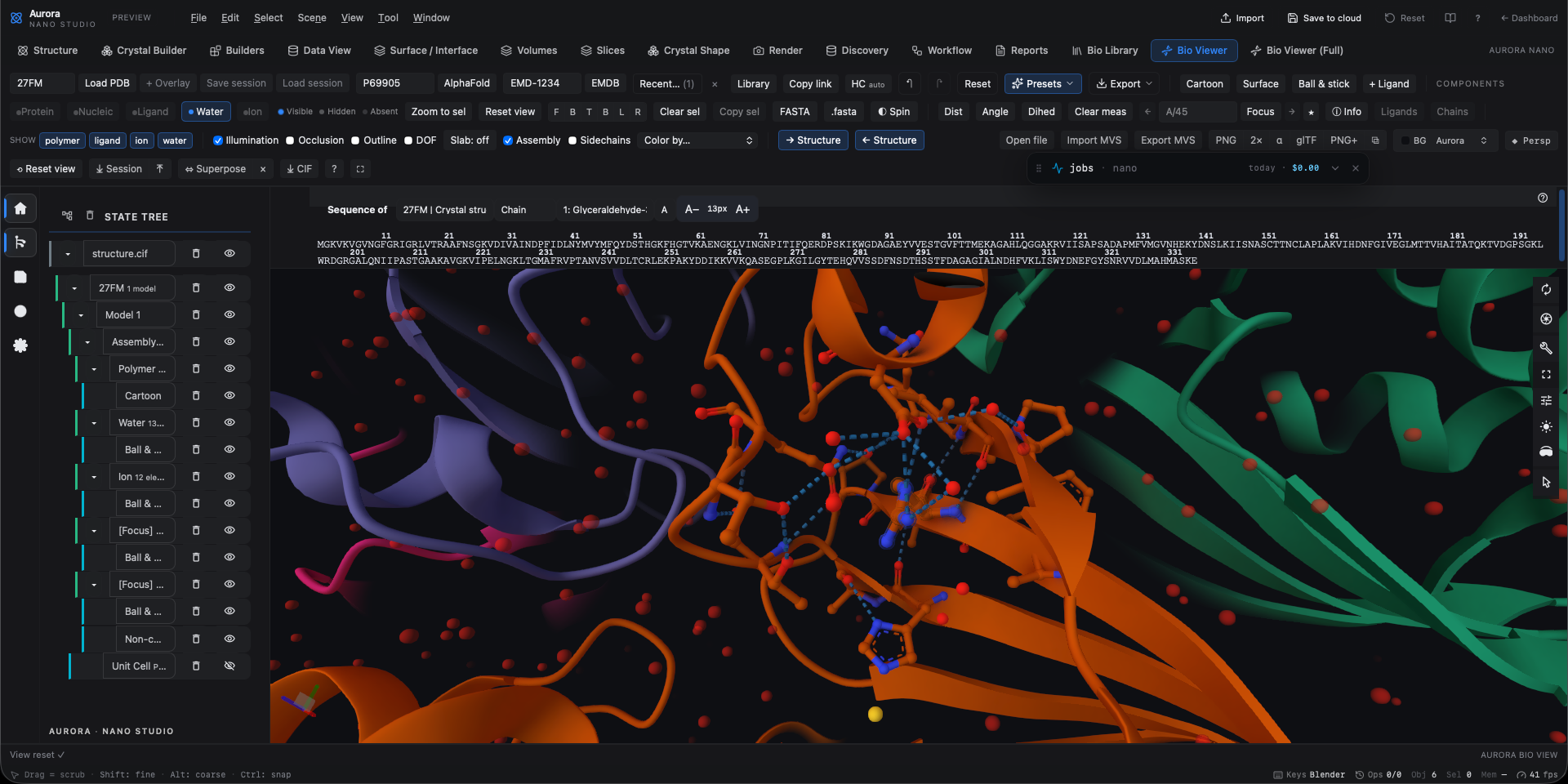
Figure 1: Aurora Bio Viewer rendering PDB 27FM (glyceraldehyde-3-phosphate dehydrogenase, UniProt P69905) with hybrid cartoon + ball-and-stick representations, live State Tree, sequence-to-3D selection sync and GPU screen-space effects.
Scene 01 · Enzyme close-up
27FM — glyceraldehyde-3-phosphate dehydrogenase
P69905 · Assembly 1 · 4 chains · water & ion shells resolved
Cartoon and ball-and-stick are hybridised on the same scene: the ribbon backbone stays legible while the active site is expanded into full atomic detail with hydrogen bonds drawn as dashed measurements. Screen-space illumination, ambient occlusion and depth-of-field are computed live on the GPU — no offline render pass.
The State Tree on the left is the actual scene graph. Every representation — Cartoon, Ball&Stick, Water, Ion, Focus, Non-covalent, Unit Cell — is a first-class node you can toggle, isolate, or export. The residue strip above the canvas stays in sync with the 3D selection in both directions.
Cartoon + Ball & Stick
State tree
Sequence ↔ 3D sync
SSAO · DOF · outline
Assembly biounits
Water & ion shells
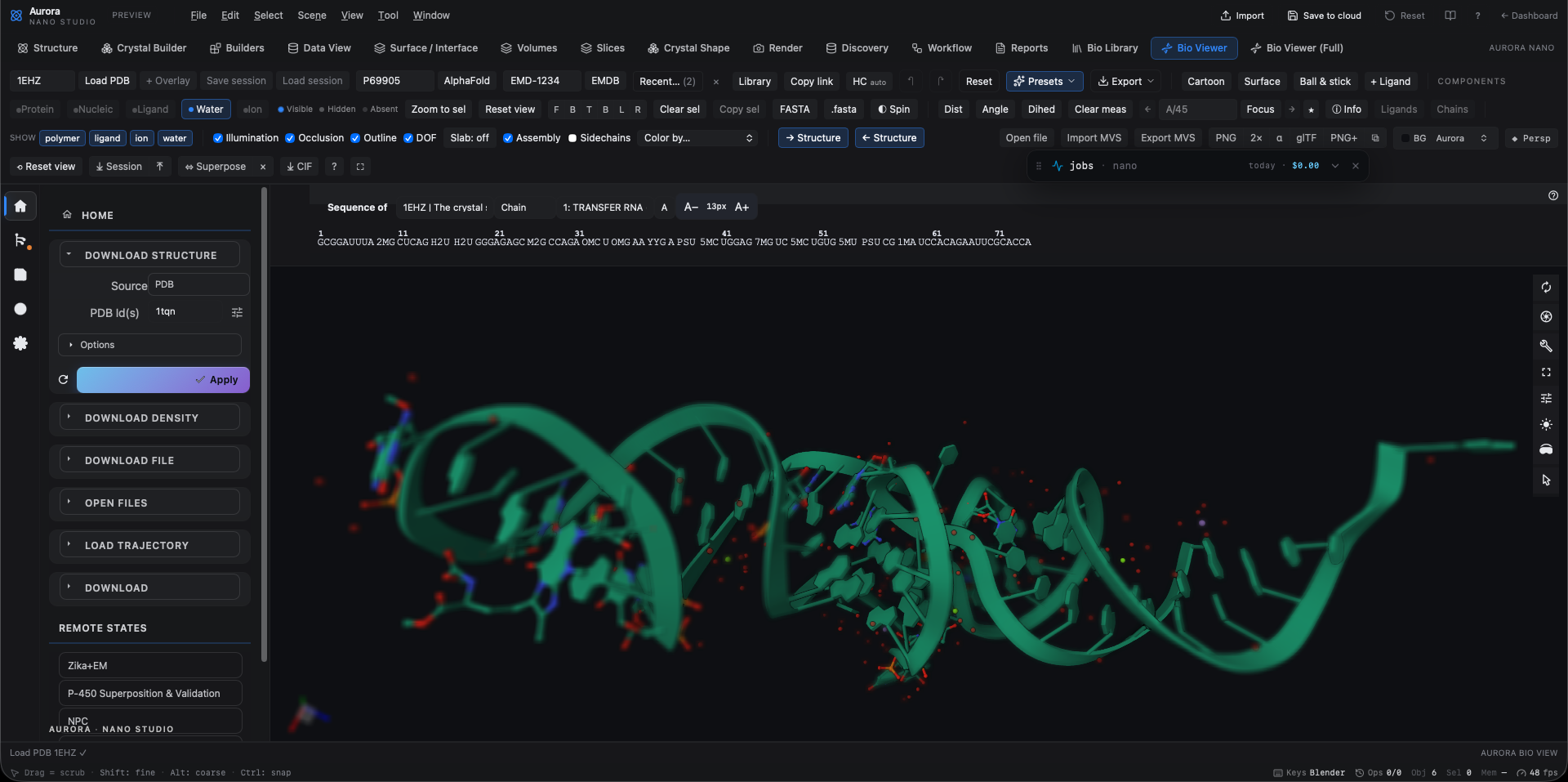
Figure 2: Aurora Bio Viewer with PDB 1EHZ transfer RNA loaded via the unified Home panel, exposing PDB, AlphaFold, EMDB density, trajectory and Remote-States loaders in a single scene graph.
Scene 02 · One home for every source
1EHZ — transfer RNA, from PDB to your workspace
RNA · 76 residues · nucleic backbone + base pairs
One Home panel talks to every provider. PDB and AlphaFold IDs, EMDB density maps, local files, and molecular dynamics trajectories all land in the same scene graph — no format switching, no separate viewers, no downloads round-tripping through the operating system.
Remote States are curated scenes we ship with the workspace: Zika + EM, P-450 Superposition & Validation, NPC, and more — each one a deep-linkable session you can open, remix, and save back to the cloud with one click.
PDB · AlphaFold · EMDB
Trajectory loader
Density streaming
Remote States
Deep-link sessions
Save to cloud
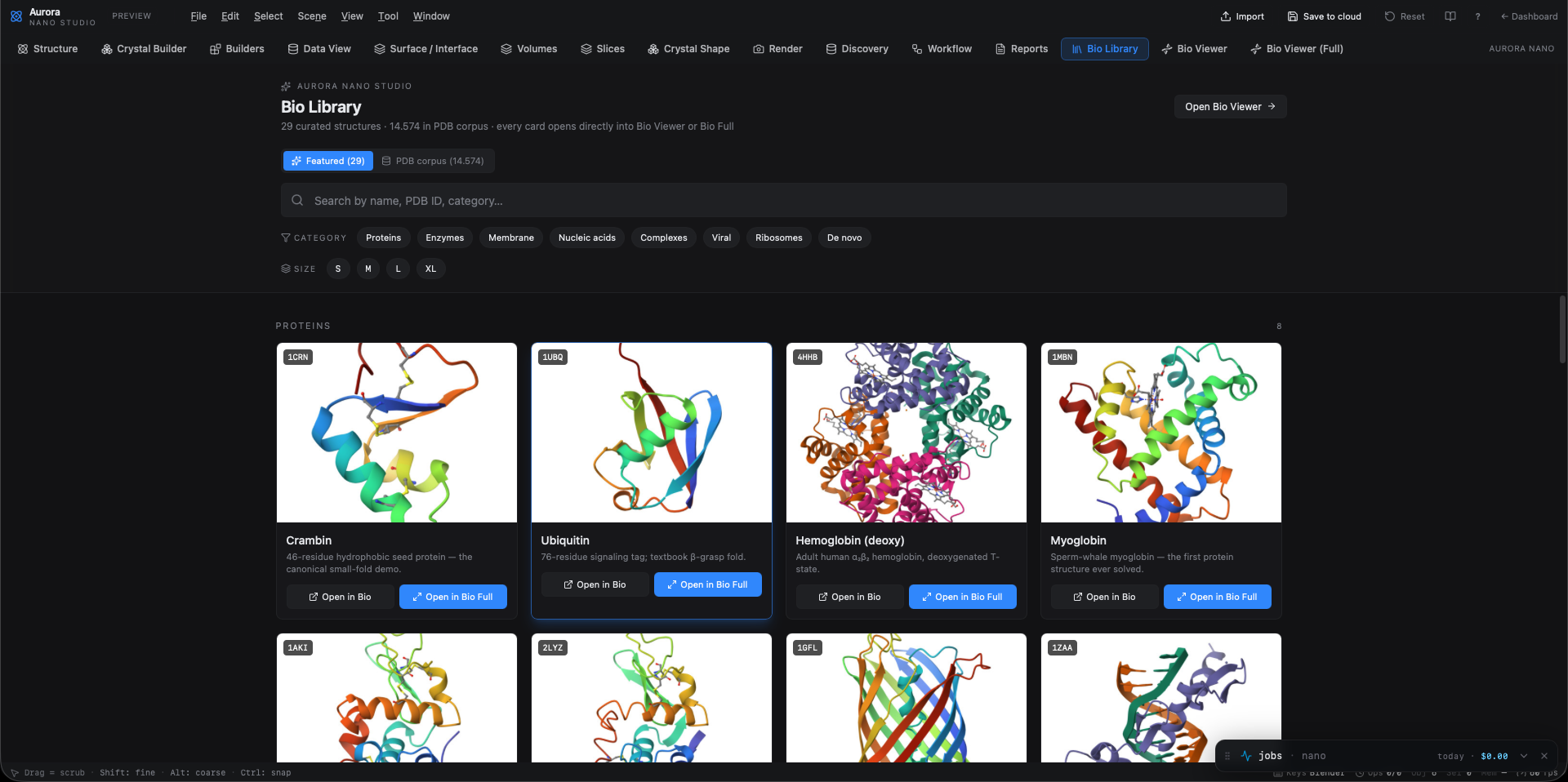
Figure 3: Aurora Bio Library — 29 curated structures indexed over a 14,574-entry PDB corpus with category and size facets, search, and direct one-click open into the Bio Viewer or Bio Full.
Scene 03 · The library, indexed
A curated shelf over the whole PDB.
29 curated · 14,574 in corpus · faceted · one-click open
The Bio Library sits at the front of every session. Twenty-nine hand-picked reference structures — Crambin, Ubiquitin, Hemoglobin, Myoglobin, GFP, Zinc-finger, Lysozyme — give you something to click the first time you open the workspace, each with a real thumbnail, a written description, and a jump directly into the Bio Viewer or Bio Full.
Behind them, the full RCSB corpus is indexed in Aurora Cloud and searchable in the same panel — filter by Proteins, Enzymes, Membrane, Nucleic acids, Complexes, Viral, Ribosomes, De novo, and by size (S · M · L · XL). Every card is a deep-link — the same URL opens the same scene on any device.
29 curated
14,574 PDB corpus
Faceted filters
Full-text search
Real thumbnails
Open in Bio / Bio Full
230k+
PDB entries synced
Live corpus, resumable ingest
60 fps
Interactive target
GPU instancing · idle-parking
1
WebGL context per tab
Leak-audited on every route change
06Diagnostics & reliability
Rendered like an engineer. Watched like an engineer.
A per-tab WebGL context that parks when idle, a leak watcher that double-samples with idle callbacks, and an in-app diagnostics panel (Ctrl+Alt+D) that exports a full debug bundle when a pilot needs one.
Diagnostics panel
FPS · memory · leaks
Leak-audited GL
double-sampled · idle
Idle-parked runtime
45 s · one context
aurora · runtimelive
Frame rate
~60 fps
steady · vsync locked
WebGL memory
< 200 MB
leak-audited · double-sampled
Contexts
1 / tab
idle-parked at 45 s
07Inside the studio
Every surface, in one place.
Click any tile to expand. The frames are rendered from the same tokens the studio uses — not stock imagery.
Technical whitepaper
Architecture, solvers, validation.
Read the full Nano Studio whitepaper for the architecture, the compute-layer contract, validation cases, and the roadmap we're shipping to pilot partners.